

Why Energy and Mining Might Lead Canada's AI Adoption
A recap of April 30th's Calgary Tech Thursday session, "How Energy and Mining Can Lead AI Adoption in Canada," featuring Keri Lee, John Mortimer, and Josh Malate.

Energy and mining don’t usually headline AI conversations. Maybe they should. They’re two of the largest industries by Canadian GDP, they’ve been generating complex high-quality data for decades, and the operational stakes are high enough that meaningful AI gains compound fast.
So when I went up to Christina Lake last October to visit Cenovus and asked the team how they were using AI, the answer gave me the impression they could be doing more. The infrastructure is there. The problems are real. And almost nobody is using AI in genuinely interesting ways yet.
But there are companies who are. Three of their founders sat down with us last Thursday.
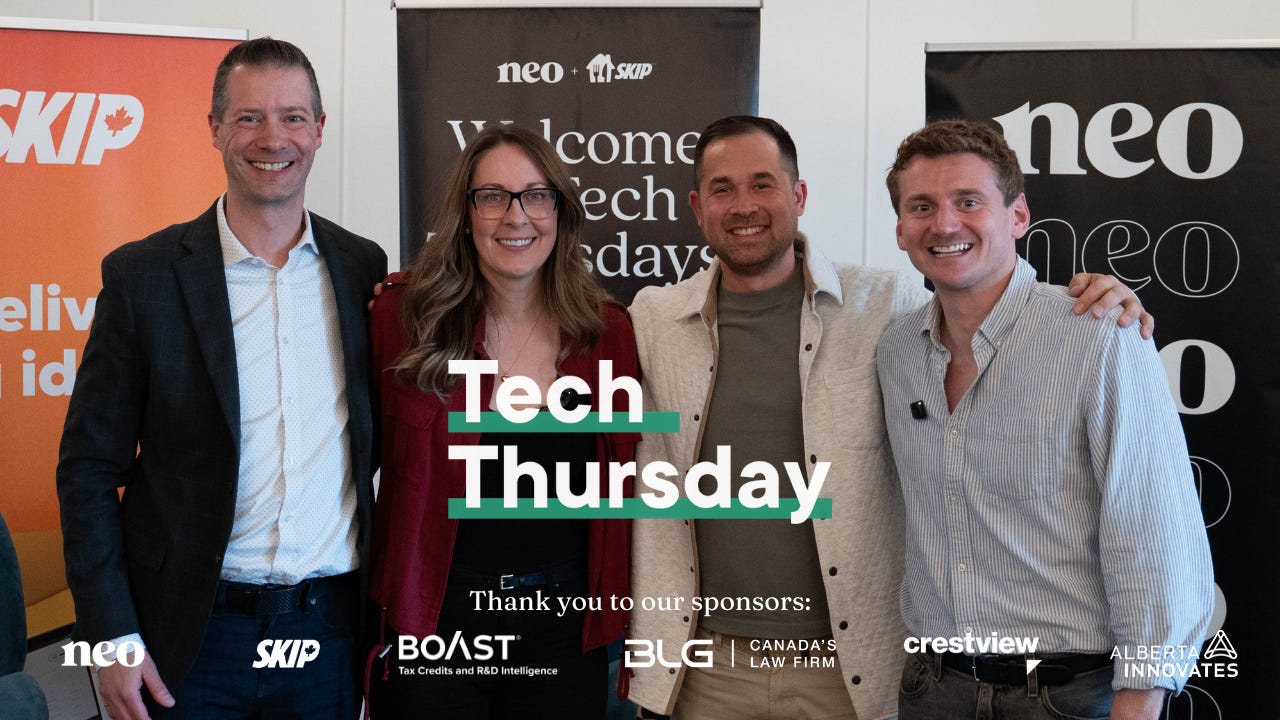
The panel featured:
Keri Lee, Managing Director and CEO of Blue Marvel AI
John Mortimer, CTO of Geologic AI
Josh Malate, Co-Founder and President of Ultimarii
This is our recap of the top ideas from the conversation.
“AI adoption moves at the speed of trust.” - Josh Malate

Missed this one? Check out our recap videos on YouTube, Spotify, or Apple Podcasts.
The Frame: The Buyer Is Different
The single biggest theme of the evening was that selling AI into heavy industry is not the same business as selling AI into the rest of the market. The customer is an engineer, a geologist, or an accountant, trained to be right rather than to iterate. The deals are slow because they should be. And the company isn’t going to die if they buy from you, but their plant might if they buy wrong.
That changes the playbook. We worked through three pieces of it: how innovators actually earn the trust to be in the room, what an AI-native energy or mining company would look like, and why heavy industry’s data moat may end up mattering more than its model choices.
1. The Speed of Trust
The takeaway: Selling AI to oil, gas, mining, and power isn’t a software sale. It’s a multi-year relationship where the innovator has to do most of the proving.
Josh Malate framed it most directly:
“AI adoption will move at the speed of trust. We need to overcome this trust barrier with customers, and there’s a whole bunch of components that come into that. We’re rooted in very specific information and data, and then we are subject matter expert informed. Not only are we a team of about 20 technologists, plus another 20 in the Philippines, but we have a team of almost 30 subject matter experts. Past leaders of regulatory bodies. Individuals who have acted on behalf of companies filing applications with regulators. We bake in the industry knowledge of folks that have been doing this for 30 years to build trust, and lead to adoption.” - Josh Malate
That trust-building is structural, not cosmetic. Subject matter experts aren’t a marketing accessory at Ultimarii. They’re a roughly equal-sized cohort to the technologists.
John Mortimer, whose team scans rocks for mining companies, described the parallel pattern in mining. The product isn’t sold to executives; it’s earned by being right in front of geologists, over and over:
“You have to characterize what’s in that ore body. The really conventional way is that you’ll write it on paper and then send it off to the other team. When we started to scan the rock, we started to give this digital view of it. The way you have to prove that it’s going to be worthwhile is that you get very, very consistent results. And the way we did that was by having geoscientists and geologists involved in the process. Saying, ‘Look, you’re looking for these sulfides. Here’s the sulfides. Here’s the tool doing this. Here’s how you can rely on that tool.’ That curve of adoption was a really long time.” John Mortimer
Why this matters: A new buyer pattern is emerging across the panelists’ customers. AI ethics committees, often led by a Chief AI Officer, now sit between vendors and the operational team. Keri framed it well: nobody quite knows what these committees do yet, but they’re real, they’re proliferating, and they’re shaping which vendors get in the door. If you’re selling AI into heavy industry, expect to meet them.
2. The AI-Native Energy or Mining Company
The takeaway: AI-native isn’t a software-versus-incumbent story. It’s a question about who has the data, who has the expertise, and how AI changes the moat.
Josh Malate offered the most strategically interesting framing of the evening, around a Microsoft-coined concept called the “frontier firm” strategy:
“As opposed to being a software company that’s leveraging this technology, selling software licensing fees and getting valued on 10x that, why don’t I just enter the market and compete with my customers and do it better than them? In our realm, we have all this intelligence about how projects get approved. If we truly have an edge on where you can site a power generation project, we can efficiently do it. Wouldn’t we be best suited to actually just raise capital on that basis and make a portfolio of bets to do so? When I think about what an AI-native oil and gas company looks like, you’re using this data and technology advantage to actually enter the market and compete against the incumbents.” Josh Malate
In other words: in some categories, the AI-native company doesn’t sell software to oil and gas. It becomes oil and gas. The capital is there for whoever proves the arbitrage.
Josh extended that to a sharper hypothetical:
“I met a friend, he has an AI operating company. He says, ‘If I put my AI operator on the wellhead, I increase production by 18%.’ And I’m like, if that’s the case, I will give you infinite money to buy every wellhead. That’s the finance theory of it. If you have created this arbitrage, then infinite capital should go there. So why isn’t that happening? There’s friction in the market.” Josh Malate
John Mortimer pulled the question back toward what AI native actually requires, structurally:
“No data, no AI. You need good quality, clean data for everything we do. And that’s actually one of the differentiators we have. There are a lot of companies that scan rock in different ways. They’ll take photos of it, they’ll scan it with one type of scanner, they’ll do various things. But to do that consistently and reliably, and within a certain tolerance over time, is really hard to do. The industry for a very long time has dealt with really bad data. Unstructured, errors, human errors, unvalidated, in different types of records. So when you start to look at the power of what an AI-native company would do, it would start with having really good access to structured data.” John Mortimer
Why this matters: Both Josh and John landed at the same conclusion from different angles. AI-native doesn’t mean replacing humans. It means humans whose judgment is amplified by structured data and good models. Josh put the philosophical version of it most clearly. As inference costs fall toward zero, what becomes scarce is high-quality human judgment. The company that wins is the one that injects expert humans into the loop most effectively.
Brought to you by:
Boast - Are you leaving innovation capital on the table? Boast combines AI-powered automation with specialized tax expertise to help tech companies maximize R&D credit returns. Join 2,000+ businesses who’ve secured $675M+ in funding. Get your free assessment at boast.ai

3. The Data Moat
The takeaway: The companies in this space are sitting on data advantages that compound. The question is who actually captures the value.
Keri Lee’s data position is one of the most interesting in Canadian industrial AI:
“We have over a hundred years of industrial data, in the five years we’ve been operating. That allows us to train pretty unique models, where we can look at things like sequences. So when an operator is in a gas plant and is running this sequence, we can help you predict what might be going wrong in another area of the plant. One of the things we’re toying around with is creating a benchmarking service. Imagine you’re a refiner located in Western Canada. Wouldn’t you like to know how you benchmark against all other refiners in your class?” Keri Lee
Geologic AI’s data position is comparable in scale and even harder to replicate, given the physical infrastructure required to generate it:
“The average time from exploration to when a mine site is active is 15.7 years. Seventy-five percent of that is exploration. What we do is trim that time down. Even once you’ve got a mining site, let’s say you’re mining for copper and you think the ore body is on the north side, and you start drilling holes and realize the south side doesn’t have as much, now you don’t have to mine it. If we can improve the profitability of that by even a few single-digit percentage, it’s huge for a mining company.” John Mortimer
The economic stake in mining is enormous, and the cycle is long enough that even partial improvements compound. John mentioned that one oil major he’d been speaking with recently burned through $10 million in cloud credits in a single week running simulations. Whoever owns and structures the data underneath those simulations is going to capture a meaningful chunk of that economic value.
Keri quantified the benchmarking-style ROI on the operations side:
“A customer we’ve been deployed with across 15 sites for over a year, we’ve reduced the number of alarm and events for them by 10 million. Very low bar would be a dollar per alarm. So we’re saving them about 10 million dollars a year in human efficiency. Those are 10 million alarms they don’t have to acknowledge and they don’t have to look at. That’s probably one or two less FTEs.” Keri Lee
Why this matters: All three panelists argued, in different ways, that the moat in heavy industry AI isn’t the model. The model commoditizes. It’s the data, the customer relationships, and the workflow integration. That favors operators with long histories and platforms with deep integration over generic AI vendors building wrappers on top of frontier models.
A Few Takeaways for Founders
A few practical points that came out for founders specifically:
The buyer is the operator, not the executive. Plant managers, geologists, and engineers will be the ones who decide whether your product survives a procurement cycle. Earn their trust first; the executive sale follows.
Your subject matter experts are part of the product. Across three different companies, the answer to “how do you build trust” was structurally the same: pair technologists with people who have decades inside the customer’s industry.
Don’t underinvest in IT and security. This is where pilots die. The OT organization wants you. The IT organization is the gatekeeper. Plan accordingly.
The data moat is real, and it’s harder to copy than the model. A hundred years of industrial data, or 2.5 million metres of scanned rock, is not something a competitor catches up to in a quarter. If you’re building in this space, your data strategy is your strategy.
The Closer
We closed the panel by asking each panelist what the next five years look like for energy and mining as a percentage of Canadian GDP.
Keri Lee pointed to the global perception of Canadian tech she encounters when traveling. “They’re like, ‘Oh, Canadian tech, you guys are vetted. This is legit. You guys have probably struggled through a lot of unpaid pilots.’ We’re very lucky to be in this province and have universities graduating these amazing engineers. We take that for granted here, but it definitely shows up when you travel.”
John Mortimer framed it through critical minerals. “We’re in a critical minerals crisis, and that crisis will get bigger. Mining companies are going to have to adapt. And in the oil and gas space, you know, a major talked about running a set of scenarios, and they burned through $10 million in cloud credits in a week. The confluence of all of this means there’s a lot of pressure on us to adapt. The AI-driven companies of the future are going to embrace that, but they’re going to do that with the talent.”
Josh Malate went the most optimistic. “I have no choice in my mind, but for the Canadian energy and mining and power generation industries to be number one in the world. We have everything we need to do so. I really see entrepreneurship as the answer. I’m meeting with junior oil and gas companies again. They’re back. What I think is cool about the technology that’s available now is that these teams can now start to build from the ground up. AI-native. SAGD was the same thing here. Those resources were not recoverable. A technology shift made them recoverable. Entrepreneurial people who took the risk built that. That’s my call to everyone. We need those people, and I think we have them here.”
Coming up at Tech Thursday:
🏦 May 21st
Topic - Building Fintech in Canada w/ Wealthsimple
Co-hosted by: Wealthsimple
Building in Fintech, and doing it at scale, leaves you with a lot of lessons. Hear directly from Wealthsimple’s engineering and product leaders about the decisions behind some of Canada’s most-used financial tools: what they launched, what they learned, and what they’d do differently. Featuring:
Channing Allen, Senior Engineering Manager at Wealthsimple & Co-Founder at Plenty
Jocelyn Jeffrey, Director of Engineering at Wealthsimple
Sam Newman-Bremang, Sr. Director of Product at Wealthsimple
Moderated by: Philippe Burns, Co-Founder at Tech Thursday
💰 May 28th
Topic - Nic Beique: The Builder CEO
Co-hosted by: Helcim
What does it really mean to be a builder? Helcim’s Founder and CEO, Nic Beique, shares what he’s been working on firsthand, from early ideas to real code. A behind-the-scenes look at how Nic explores “0 to 1” opportunities: the experiments, the trade-offs, and the ideas that don’t sit on a traditional roadmap. Featuring:
Nic Beique, Founder & CEO at Helcim
Moderated by: Philippe Burns, Co-Founder at Tech Thursday
Enjoyed this recap? Subscribe to not miss another Tech Thursday recap, and keep an eye out for our brand-new on-site interview series, Tech Thursday: House Calls, launching soon.